
Komatsu Helps Restoration Efforts In West Virginia
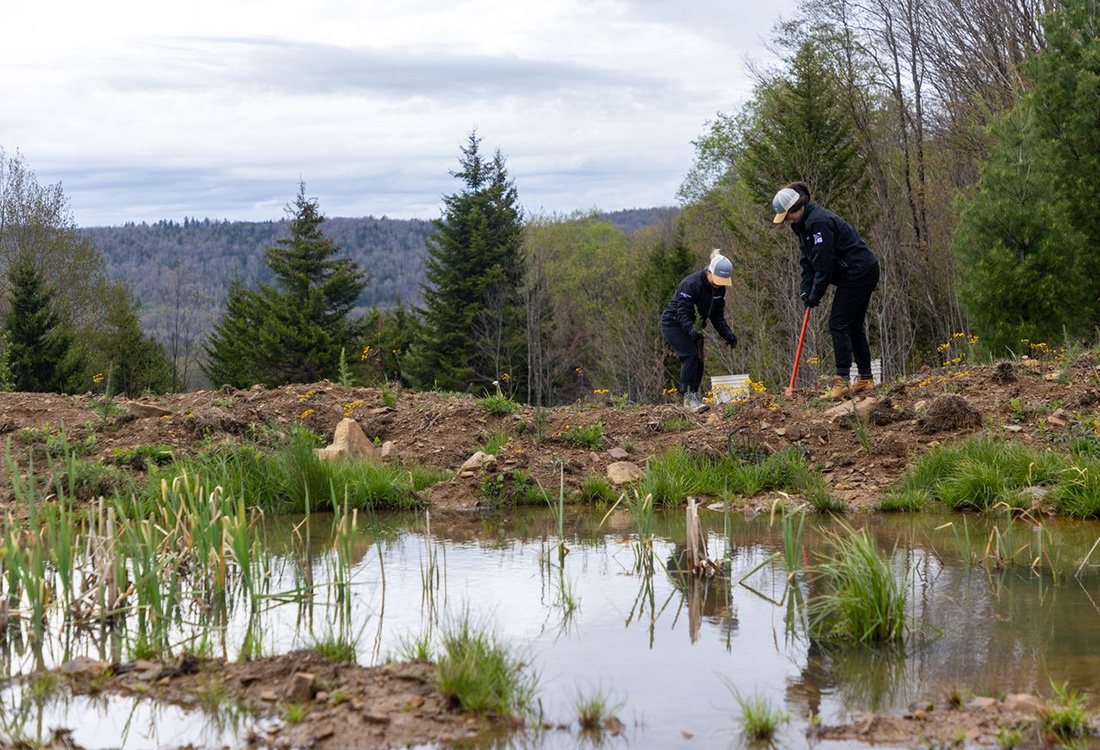 In honor of Earth Day, Komatsu employees once again joined non-profit partner Green Forests Work (GFW) as part of an ongoing reforestation partnership. On April 29, the Komatsu team planted more than 1,200 seedlings at the Mower Tract in West Virginia’s Monongahela National Forest, an area that has been undergoing reforestation since 2010.
The project, which Komatsu has supported since 2019, is a large-scale ecological restoration effort. With support from Komatsu, non-profit organizations and the U.S. Forest Service, approximately 1,500 acres have been restored on this site, including the creation of more than 1,000 wetlands and the planting of nearly a million trees. This year’s event focused on planting trees in an area where more than 100 artificial retention ponds and basins had been drained. These water features were originally created to capture sediment generated by the mining process. However, due to the lack of shade in this area, warm-water runoff from these ponds caused thermal pollution, harming a robust trout population in a nearby stream. Reforesting these areas will provide shade for any remaining downstream runoff and help ensure a balanced ecosystem for the trout population and other species that overheated waterways may harm.
Komatsu’s partnership with GFW over the past seven years has resulted in the planting of more than 700,000 trees on formerly mined lands. Ground preparation remains a critical component of reforestation success. Techniques such as soil ripping help break up compacted layers, allowing water penetration and improving conditions for root growth. This groundwork has been done through the years using many Komatsu dozers, excavators and wheel loaders—either loaned to GFW or operated by contractors that own Komatsu equipment.
“Reforestation is meaningful to Komatsu, because it represents responsible stewardship of our natural resources,” says Rod Bull, CEO, Komatsu North America. “Partnering with an organization like Green Forests Work to reforest lands that were once mined gives us the opportunity to be part of the circular economy in a way that reflects our long-term commitment to responsible land use and supporting a more sustainable future.”
Latest news
LIGNA 2027 Announces Guiding Theme: Woodbound Future
LIGNA 2027, to be held May 10-14, in Hanover, Germany, will be held under a unifying theme: Woodbound Future. With this theme, the organizers Deutsche Messe and the VDMA Woodworking Machinery Assn. establish a clear…
California County Advances Biomass CHP Project At Placerville Jail
The El Dorado County Board of Supervisors gave conceptual approval October 27 to move forward with planning and a feasibility study for a woody biomass combined heat and power (CHP) system at the Placerville Jail…
NWABF Secures Funding Partner For $3 Billion Woody Biomass-to-SAF Project
Northwest Advanced Bio-Fuels (NWABF) has entered into a strategic funding partnership with private equity firm Black Gold Equity Partners to support capital deployment for a planned $3 billion woody biomass-to-sustainable aviation fuel (SAF) biorefinery in…
Michigan State Research Explores Using Storm-Damaged Timber For Biochar
A Michigan State University researcher has been awarded a $300,000 grant from the U.S. Department of Agriculture National Institute of Food and Agriculture (USDA NIFA) to explore a new use for timber damaged by recent…
Find Us On Social
Subscribe to Our Newsletter
Wood Bioenergy News Online hits the inboxes of subscribers in the wood-to-energy sectors.
Subscribe/Renew
Wood Bioenergy is published and delivered worldwide 6 times per year. Free to qualified readers in the U.S. Subscribers outside the U.S. are asked to pay a small fee.
Advertise
Complete the online form so we can direct you to the appropriate Sales Representative.