
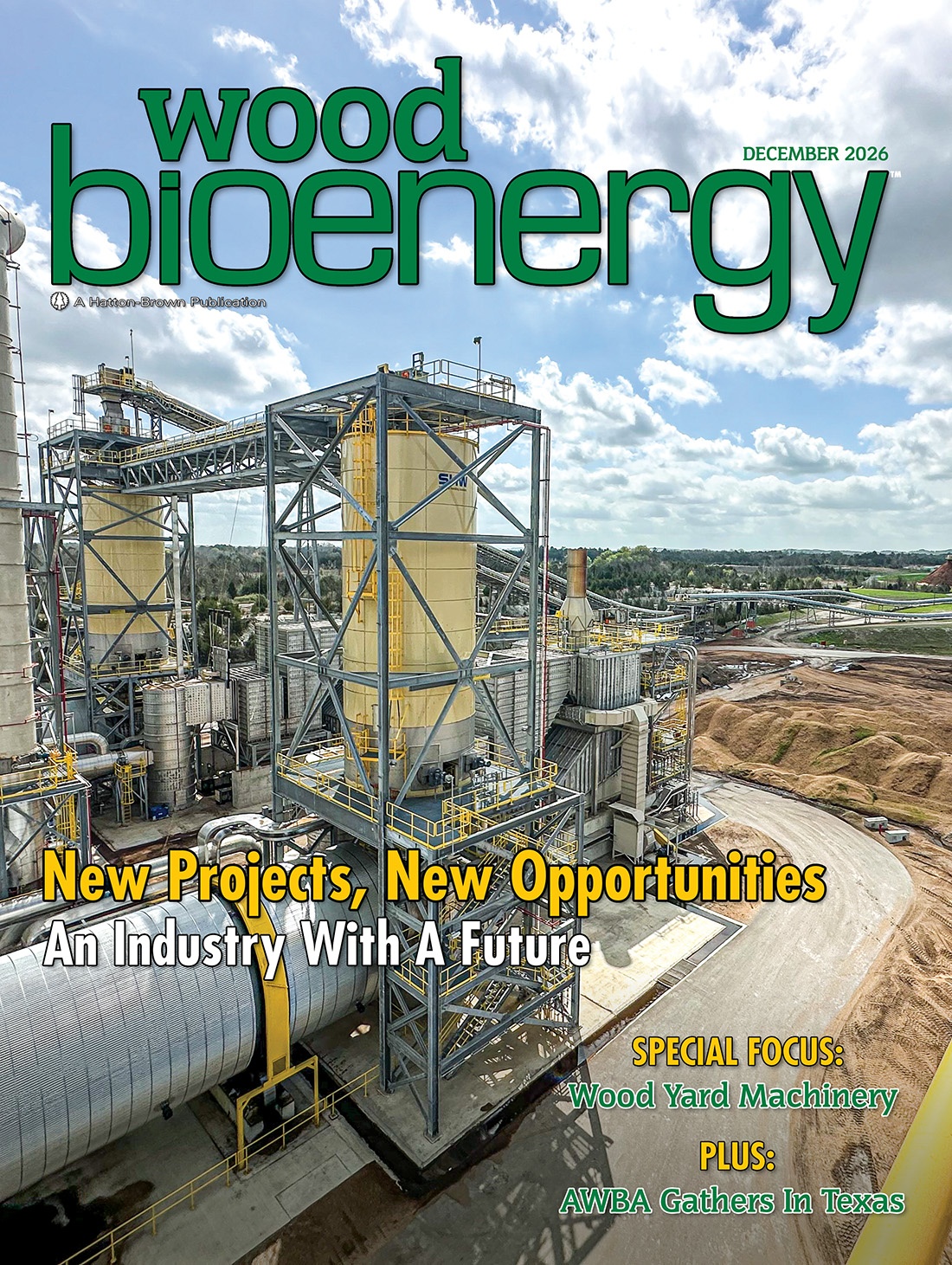
Inside this issue
FROM THE EDITORS
Wood Bioenergy’s Next Chaper?
IN THE NEWS
- Drax To Build Data Center
- NWABF Secures Funding Partner
- Research Looks At Timber For Biochar
- CA County Advances Biomass CHP Project
- CM Biomass Becomes Northflare Energy
- $5.5 Million Granted To Grow Markets
- Cal Fire Awards $10M For Biomass Projects
- Endowment Awards $500k For Forest Tech
- FS, State Agencies Renew Forest Health MOU
- SBC Launches Utilization Initiative
- Biochar Facility Coming In La.
Advanced Woody Biomass Alliance Takes Over Texas
THE WOODLANDS, Tex. The Advanced Woody Biomass Alliance (AWBA) brought the global biomass industry together October 19-20 in The Woodlands, Tex., for two days of discussions centered on the evolving role of woody biomass in energy, fuels and renewable carbon markets. From emerging conversion technologies to the practical challenges of securing fiber and financing new projects, the conference addressed both opportunities and obstacles facing the industry.
Product News
- Spotlighting The Partnership Of Solagen, Classen Apparatebau Wiesloth
- CPM Names New CEO
Find Us On Social
From the Editors
Wood Bioenergy’s Next Chapter?
The wood bioenergy industry is often described as if its future rests on a single question: Will one major power producer burn more or fewer pellets? That is too narrow a frame. The industry is changing across markets, feedstocks and technologies, and the forces shaping it extend well beyond any one company or subsidy on another continent.
These hard truths were well on display during the recent International Conference on Processing Technologies for the Forest and Biobased Industries in Saint Simons, Ga. Described as a growing market, pellet demand is supported by not just power generation in Europe but also rising demand for domestic heating and industrial applications. Of course, at the same time, producers Stateside have to navigate volatile fuel and freight costs, an extremely volatile policy environment and uneven demand. Despite (or perhaps in spite of) these challenges, the presentation underscored that the industry is far from standing still. Not every opportunity is guaranteed, but there are opportunities.
A policy change or a subsidy reduction may alter the economics of a particular plant, but it does not, on its own, settle the prospects for wood bioenergy. Markets respond to a wider set of conditions: Competing fuel prices, grid needs, weather, infrastructure, contracts and the availability of dependable supply. The industry’s future will be shaped by how well it understands—and adapts to—that whole system.
Obviously, pellets serve different needs in different places. In Europe, high natural-gas prices (combined with government mandates) have strengthened the appeal of pellets for heating and electricity generation. In other markets, like Asia, co-firing and industrial uses as well as an emerging demand for specialized products, should be getting some attention. Diversity can be a source of resilience.
But promise alone cannot sustain production. Plant output has to align with vessel schedules and customer requirements, which is why one producer said long term contracts can provide needed stability. While spot-market activity can offer opportunities, it also brings more risk: A dependable contracted sale is preferable to producing a shipload with no confirmed destination.
Demand forecasts alone do not make a market. Logistics, working capital, port access and shipping costs matter just as much. The experience of U.S. East Coast producers facing constraints on shipments to Asia illustrates how a distant bottleneck can affect regional prospects. A market may be attractive on paper and still be difficult to serve competitively.
The strongest case for innovation may begin not with a new market, but with fiber already looking for one. Look at the loss of pulp and paper capacity in Georgia and the resulting pressure to find uses for substantial volumes of wood fiber. When established buyers close, rural economies and forest-based supply chains feel the impact.
There may be customers willing to pay a premium for lower-emissions products, especially where procurement commitments or regulation create a market. But those markets will not scale on aspiration alone. Producers will need reliable technology, verified emissions performance and transparent supply chains.
The industry’s immediate task is to make better use of fiber while adapting to a changing energy system. Its longer-term task is to earn confidence from customers, communities and policymakers that growth is compatible with responsible forest management and credible climate goals.
That means resisting two easy narratives. One says that pellets are finished whenever a subsidy changes. The other says that every use of biomass is automatically sustainable. Neither is adequate. The sector needs to show where products make sense, where they do not, and what safeguards are necessary.
Wood bioenergy’s next chapter will not be written by a single power plant, one technology or one forecast. It will be written by the choices made across forests, mills, ports, grids and end markets. The industry has ideas worth testing and material worth using.

From Left: Jessica Johnson, Managing Editor; Dan Shell, Senior Editor; Rich Donnell, Editor-in-Chief; David Abbott, Senior Associate Editor
Want more content?
Wood Bioenergy is published and delivered 6 times per year tosubscribers worldwide. Readership includes corporate executives, mill ownership, mill management, logging contractors and equity venture interests. Wood Bioenergy is FREE to qualified readers.
Latest News
Drax Announces £20bn Partnership To Build Data Center At Drax Power Station
Drax, Brookfield and Radiant, Brookfield’s UK-headquartered AI infrastructure platform, have announced a new strategic partnership to jointly develop, deliver and operate GW-scale data center capacity at Drax Power Station in North Yorkshire, UK. The Brookfield-Qai…
Sierra Business Council Launches Biomass Utilization Initiative
The Sierra Business Council (SBC) has launched a new Wood Utilization Initiative to expand opportunities for use of forest biomass and underutilized wood across the Sierra Nevada. The initiative will support forest resilience, local economic…
GeorgiaSAF Moves Forward With Commercial‑Scale
CarbonCore Inc. has advanced plans for its GeorgiaSAF program, confirming Bainbridge and Decatur County as the focus of development for a proposed commercial‑scale sustainable aviation fuel (SAF) facility in Southwest Georgia. The project aims to…
LIGNA 2027 Announces Guiding Theme: Woodbound Future
LIGNA 2027, to be held May 10-14, in Hanover, Germany, will be held under a unifying theme: Woodbound Future. With this theme, the organizers Deutsche Messe and the VDMA Woodworking Machinery Assn. establish a clear…
California County Advances Biomass CHP Project At Placerville Jail
The El Dorado County Board of Supervisors gave conceptual approval October 27 to move forward with planning and a feasibility study for a woody biomass combined heat and power (CHP) system at the Placerville Jail…
NWABF Secures Funding Partner For $3 Billion Woody Biomass-to-SAF Project
Northwest Advanced Bio-Fuels (NWABF) has entered into a strategic funding partnership with private equity firm Black Gold Equity Partners to support capital deployment for a planned $3 billion woody biomass-to-sustainable aviation fuel (SAF) biorefinery in…
Subscribe to Our Newsletter
Wood Bioenergy News Online hits the inboxes of subscribers in the wood-to-energy sectors.
Subscribe/Renew
Wood Bioenergy is published and delivered worldwide 6 times per year. Free to qualified readers in the U.S. Subscribers outside the U.S. are asked to pay a small fee.
Advertise
Complete the online form so we can direct you to the appropriate Sales Representative.